Friday, June 17, 2016

San Miguel de Tucuman - The birthplace of independence

Government House in San Miguel

San Miguel de Tucuman is the capital of Tucuman province and is the place at which Argentinian independence was declared on 9 July 1816.

The bicentennial is this year so unfortunately many of the sights were closed to prepare for the celebrations.

In the centre of the city is the original government house. It's a very unassuming building considering its significance and I was assured that it was much more impressive Inside - however it was closed due to the bicentennial.

Independence House

As San Miguel is quite an old city, there are many examples of Spanish style architecture - including a Spanish market. Sadly the market has closed and in a fit of architectural vandalism, a Hilton hotel and boutique shops have been allowed to be built there.

This is how the market looked before:

This is how it looks now:

Which is ok, until you take a step back:

It is a grand pity that this beautiful building has been ruined.

However, San Miguel de Tucuman has many other more beautiful buildings such as its many churches,

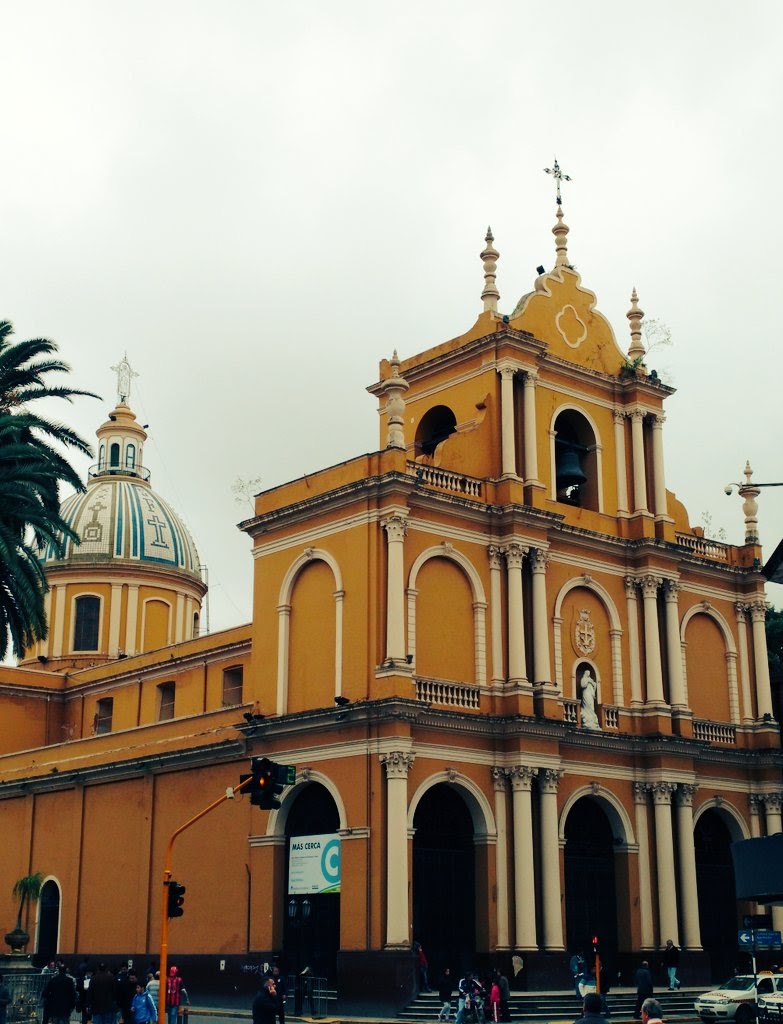
San Miguel Cathedral


The Cathedral from another angle
St Francis Church 

La Merced Church 

An amphitheatre (which was once a swimming pool),

The Amphitheatre

And the very impressive government house:

Government House at night

Outside of San Miguel in a little town called Simoca there is a traditional market on Saturday. The market claims to be 300 years old and is one of the oldest in Argentina.

The entrance of the market

It sells all types of food, clothing and souvenirs.

Items for sale

Pigs - both live and butchered

Including the traditional "Pastel de Novia" (Girlfriend Cake).

Pastel de Novia

The cake consists of beef, dried fruit and sweet cake covered in meringue. Although it is a strange mixture of sweet and savoury, it kind of works in an odd way.

In general the food in Tucuman was very good - the epanadas in the North are superior to those in Buenos Aires and the champion of epanadas can be found in Tucuman.

 If you visit be sure to seek out the old lady with the basket of empanadas across from Independence house in San Miguel - you'll not regret trying these champion delicacies.

Thursday, June 2, 2016

Cafayate: Wines and Wilderness

Vines in Cafayate

Cafayate is a wine growing town in the Salta province in Northern Argentina. The town boasts several bodegas within easy walking distance, so wine tasting is a popular activity in the town.

Bodega Domingo Hermanos

Bodega Domingo Hermanos is within the town itself and runs tastings along with a short tour of the winery. As with most wineries in the area, they produce Malbec and Torrentes wines. The Malbec from this winery was particularly good.

Bodega Nani

Bodega Nanni has a wider variety of wines on tasting and an excellent Tannat.

Bodega El Tránsito

Across the road from Nani is the El Transito bodega which has a small range of wines on tasting - none of which stood out particularly.

Further afield (about 1 km from town) is the Estreco bodega which has an extensive variety of wine on tasting.

Bodega Estreco

This bodega, along with a very good malbec, produces an excellent Chardonnay under the "Circulo" label.

Even further afield (5km) is the Mounier bodega.

Bodega Mounier

This bodega is situated under the surrounding hills and the walk to the winery gives views across Cafayate.

The road to Mounier

The view from the road

Apart from the excellent wines, Cafayate is close to an interesting set of coloured mountains, The Quebrada.

The coloured hills of the Quebrada

There are several tour companies in Cafayate that can drive you to do several short hikes through the incredible landscape.

Many colours

There are many formations created by the erosion of wind and rain such as the Window:

And The Toad:

There are also several deep gorges such as The Devil's Throat

The Devil's Throat with people for scale

And The Amphitheatre, where concerts are held occasionally to take advantage of the acoustics of the gorge.

The Amphitheatre

Apart from the interesting formations the scenery of the Quebrada itself is quite spectacular.

View from Tres Cruces


The valley from Tres Cruces

Saturday, May 28, 2016

Amaicha and the Quilmes ruins

A cactus with the Quilmes ruins in the background

Over the hills from Tafí del Valle is the tiny town of Amaicha. Even though it is only a few hours bus ride away the landscape is entirely different to the lush green of Tafí.

Once the bus has driven over the high mountains (3000m) the landscape changes to an arid landscape.

The road to Amaicha

The town itself is a tiny village of dirt roads surrounding a small plaza.

The main plaza

There isn't much to see within the town itself, but close by are several treks through the arid scenery.

Around 8 km from the town is a short trek to a small waterfall. The trek brings you through a spectacular canyon formed by erosion from the river.

The canyon entrance

The trail winds down a steep path to the river that flows out of the canyon.

The river at the canyon entrance

The trail then follows the river as the canyon walls surround you.

Looking back from inside the canyon

Until it reaches a small waterfall.

The waterfalls

There is a ladder that leads to the second set of falls.

The second falls

The trail stops at this point and you have to retrace your steps to exit back into the river valley which you can then follow back to Amaicha.

The river valley

The other point of interest in Amaicha are the Quilmes ruins - the ruins of a pre-Incan town that successfully resisted Spanish control for 130 years.

The ruins are about 15km out of Amaicha and are easily reachable by taxi. They are situated on the side of a steep hill overlooking a flat plain. 

The Quilmes ruins

From the topology of the landscape, it is easy to see just how defensible this settlement was.

The plains overlooked by the ruins

From the entrance you are able to walk through the ruins and there are short free guided tours of the lower parts of the site.

The lower part of the ruins

And after you can climb the steep hills for a birds-eye view of the site. Which at one stage had more than 1000 inhabitants.

The ruins from the hills


A view from higher up

The ruins and the plains

The Quilmes people eventually succumbed to the Spanish invaders and were rounded up and forcibly marched thousands of kilometres to Buenos Aires to a settlement that still bears their name. Inevitably many died on the march and in the new settlement at Quilmes in Buenos Aires.

The descendants of the Quilmes people have now returned to the Quilmes community and have restored and protected the ruins as an important part of their history.

A geko amongst the ruins


Friday, May 20, 2016

The valleys of Tucuman Province: Tafí del Valle and El Mollar

Tafí del Valle

Tafí del Valle and El Mollar are two small towns in Tucuman province, North of the capital, San Miguel.

They are easily accessible by bus which winds up the many curves into the mountains before eventually heading down into the valleys which are still over 2000m above sea level.

A statue of an indigenous messenger on the road up the mountain


Tafí del Valle is the larger of the two towns set in amongst the hills surrounding the valley.

The town is quite rural with horses and other livestock often grazing on the side of the dirt roads in the town.

Llamas grazing

The town is surrounded by many hills from which you can get a panoramic view of Tafí and the surrounding valley.

The trail to the hills starts just out of town across the Rio Banda.

Rio Banda

Soon after the river the trail becomes very steep as you begin the ascent into the hills.

The trail up the hill

From the trail you can see all of Tafí de Valle all the way to El Mollar.

Looking down the valley to El Mollar

At the top of the hill is a cross (of course) and from here you can see all of the valley.

The cross and some four-legged companions I picked up along the way


Tafí del Valle


Looking towards El Mollar

The trail continues into the hills but sadly the weather was turning bad so I had to head back to Tafí to enjoy some local delicacies.

Clouds over the trail


Locro - a local stew of pumpkin, beans and meat


Delicious local wine

Cayote with nuts - the fruit is slow roasted with sugar and eaten with nuts.

After a night's feasting, the next day I was ready to explore the nearby town of El Mollar.

The main square in El Mollar 

El Mollar is a tiny town on the edge of a large dam around 15km from Tafí del Valle. It's accessible by local collectivo via very bumpy dirt roads from Tafí. 

La Angostura dam

The town boasts a collection of important archaeological artifacts - Los Menhires.

Los Menhires

These stones were originally stood in front of the houses of the local indigenous people and could be found all around the valleys. Unfortunately many of the stones were vandalised, stolen and even used to construct bridges and roads so they were all moved to a secure park in El Mollar. The curators of the park have tried their best to recreate the position and orientation of the stones.

Designs carved into the stones - often faces or representations of animals

Unfortunately the reconstruction is mainly guesswork as many of the structures had already been dusturbed.

A reconstructed stone circle

The other reason why many of the stones were moved was to make way for a dam in El Mollar. The dam now provides a recreational area for the locals and a habitat for local birdlife but sadly has destroyed some of the valley's indigenous heritage.

La Angostura dam